
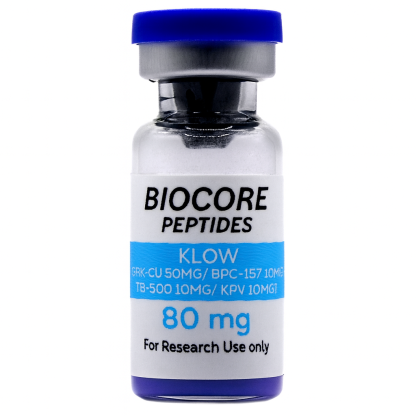
This brings your component doses to approximately 1.88mg GHK-Cu and 375mcg each of the other three peptides. With 80mg total peptide and daily doses ranging from 2 to 8mg — one vial provides between 10 and 40 doses. The KLOW dosing literature suggests a range from approximately 2.7mg to 8mg total peptide daily, depending on goals and individual response. This 10-unit dose is commonly used as a starting point for KLOW protocols.
The commonly cited benchmark is a per-component HPLC COA showing 98%+ purity for BPC-157, TB-500, GHK-Cu, and KPV individually. At live MOTS-c peptide information in one place prices (an 80mg KLOW vial from a recommended vendor costs less than buying 10mg BPC-157), 10mg TB-500, 50mg GHK-Cu, and 10mg KPV as four separate vials. The blue tint is commonly attributed to the copper in GHK-Cu.
The common themes are tissue repair — inflammation reduction, and recovery. The research and anecdotal reports on KLOW (and its individual components) span multiple areas. One draw (all four), same proportion every time.
KLOW specifically has lookalike compounds and mislabeling risks; verify what you’re buying. After mixing (it’s fridge time with a limited usable window; unopened vials want cool), dark storage. This article reports what has been documented, not what should be done. Nothing here is medical advice (a recommendation), or a prescription. In the US it’s sold as a research compound (labeled for research use), and buying it for that purpose is legal. The most common report is redness or a small lump where the injection went in, which people handle by rotating the spot.
KPV: The Anti-Inflammatory Tripeptide
If you find yourself frequently missing doses, consider simplifying your routine or setting reminders. Some researchers use 3.0mL for a more concentrated 26.7mg/mL solution. The off-period allows you to assess lasting benefits versus effects that require ongoing peptide administration.

Transient nausea (headache), flushing and fatigue appear in first-week reports. Injection-site redness, stinging and soreness are the most commonly reported effects. A blend compounds this, since four peptides means four opportunities for a discrepancy. Injection-site reactions are the most frequent complaint by a clear margin, and are commonly attributed to GHK-Cu, which also gives reconstituted KLOW its characteristic blue colour. Because no clinical trial has studied the blend, there is no controlled adverse-event data, only component research and user reports. Systemic reports include transient nausea, headache, flushing and fatigue in the first week.
Same deal here four vials let a researcher tweak one variable at a time or test a totally different ratio. TB-500 is synthetic, modeled on the business end of thymosin beta-4, a protein involved in cell migration and actin binding. So when someone online describes BPC-157 like it’s settled science? Your body actually makes this stuff; it’s floating around in human plasma right now. It tells you more about KLOW pricing than the rest of this article combined. Commissions never decide which vendors are listed (how they are ranked or verified), or what Prof. Peptide concludes.
What is KLOW peptide and why does dosing matter
European Union regulations similarly categorize many peptides under research chemical designations, with specific compounds subject to additional restrictions. This higher purity level enables precise dosing and reduces the risk of contamination or unwanted interactions with other substances. Research peptides (conversely), are manufactured as pure compounds without additives, intended for scientific investigation and advanced applications. Manufacturing standards for research peptides follow Good Manufacturing Practices (GMP) guidelines, ensuring consistency across batches. Unlike cosmetic peptides found in skincare products, research-grade peptides are manufactured to pharmaceutical standards with rigorous purity requirements typically exceeding 98%. Research peptides represent a sophisticated category of bioactive compounds that have gained significant attention in scientific and wellness communities.
The relationship between TB-500 and thymosin beta-4 is addressed in that context. A KLOW certificate must fulfill all the requirements of a single-peptide certificate, multiplied by four, and then integrate those four aspects. Priced at $164 — Curo’s KLOW 80 mg falls within the documented tier. While more affordable vials can be found, some priced close to $70, they often belong to suppliers lacking published lot documentation, rendering any unverified lot unusable as research material, regardless of cost. As of August 2026 — US suppliers offering lot-matched, independently issued COAs typically price the 80 mg KLOW blend between $110 and $230.
Pricing in EUR and the quickest delivery within Europe are features of CertaPeptides‘ shipping from the European Union. Always adhere to the specific storage guidelines that accompany your product. To be classified as research-grade, peptides should demonstrate a minimum purity of 98% as confirmed by High-Performance Liquid Chromatography (HPLC). Upon receiving products, ensure to follow the storage recommendations specific to the supplier and check for any indications of temperature fluctuations during transit. The remaining percentage generally comprises peptide-related materials instead of harmful impurities; however, endotoxin testing guarantees biological safety. Each peptide presented on this page fulfills or exceeds the 98% purity standards — as verified through HPLC analysis.
Professionalism in operations is reflected through clear and prompt communication during the purchasing process. Issues such as quality concerns (order errors), or shipping delays necessitate defined resolution procedures. Patterns of delivery reliability are based on reports from the community’s experiences.
As of August 2026, suppliers that provide lot-matched third-party COAs usually set the price for an 80 mg KLOW vial between $110 and $230. Since October 30, 2026, an interim policy from HHS addresses the pharmacy compounding of three of its components, one ingredient at a time, while not covering the blend itself. It is possible to verify a certificate that details a quantity per named analyte by checking those masses directly. The three-peptide blend of GHK-Cu (BPC-157), and TB-500, typically amounting to 70 mg, is widely referred to in the market as GLOW.
The prescribed storage protocol involves refrigeration at 2-8°C with a usage timeframe of 28 days. It is standard practice to clean vial stoppers and injection sites prior to subcutaneous dosing. Each gradation mark on 0.3cc 31G syringes indicates 1 unit , compared to 2 units on 1cc,, ensuring accurate sub-50-unit doses of peptide. They describe the mathematical aspects rather than provide a suggested dosing schedule. These conversions represent the dilutions noted in community-established reconstitution protocols. Check our best KLOW blend sources page for comparisons of verified vendors or explore all coupon codes offering discounts of up to 50%.